





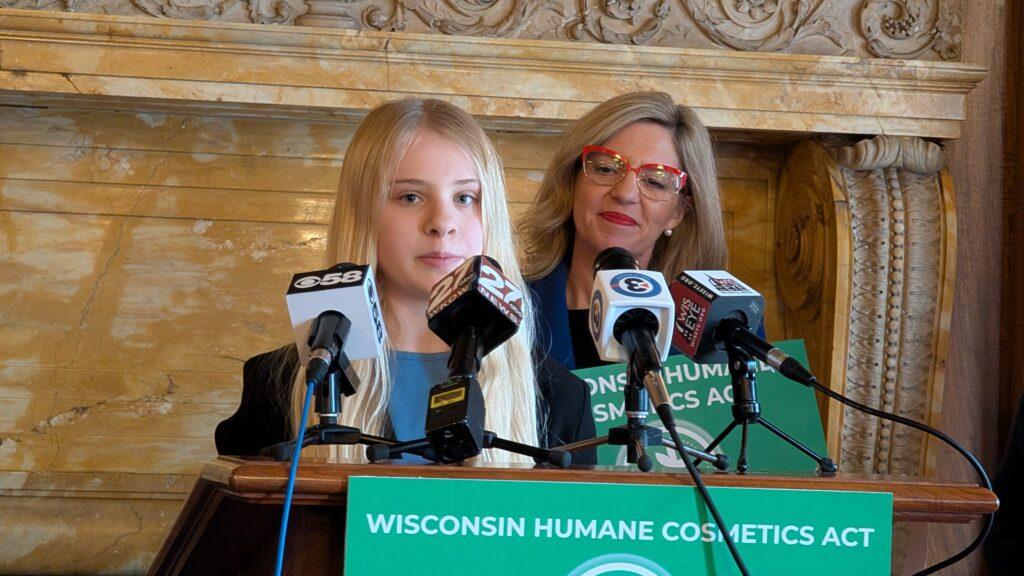


“Although the total number of animals and testing facilities are not disclosed to the public, this doesn’t stop the fact that any amount of unnecessary testing is too much,” Wurzburger said at a press conference in the Wisconsin State Capitol on Tuesday.
The middle school student was joined by Democratic lawmakers including Rep. Robyn Vining (D-Wauwatosa), who represents the young advocate and helped her work on the bill. The bill’s lead authors are Rep. Christine Sinicki (D-Milwaukee), Rep. Angelito Tenorio (D-West Allis), and Sen. Mark Spreitzer (D-Beloit). Vining described her constituent as the “driving force” behind the legislation before passing the microphone to allow Wurzburger to speak about the issue.
Wurzburger said her concerns about animal testing started after she became a vegetarian a couple of years ago. A meal on a cruise spurred her decision.
“It had an all-you-can-eat buffet, and I was actually eating a hamburger, and I was looking at, like all the waste I saw, the animal products and stuff,” she said, “I was like, this is a lot of waste, and this needs to be stopped.”
Wurzburger explained at the press conference that animal testing involves putting cosmetic products, including perfume, nail polish, makeup and hair products, on the skin, eyes and other body parts of an animal.
“It’s basically just seeing how it reacts with them, and it’s cruel and inhumane,” she said.
Wurzburger first contacted Vining two years ago and has worked with her since — contacting members of Congress from across the country, reviewing legislation in other states and meeting with Wisconsin Legislative Council to work on the bill draft. She said that in the beginning she wasn’t getting much response from lawmakers.
“That was kind of frustrating, but it worked out,” Wurzburger told the Examiner.

Vining complimented her constituent’s work, emphasizing that Wurzburger worked on the issue outside of school and saying she brought printed documents to their meetings with highlighted areas, notes and questions.
“You did difficult research,” Vining said to Wurzburger while they spoke with the Examiner. “You were sorting through bills from the federal level and Virginia, and you kept going through and figuring out what you thought was the right way to do something… if you were writing it for Wisconsin.”
Members of Congress have introduced proposals to implement a federal ban on cosmetic animal testing as recently as last year, but none have been successful. There are at least 45 countries that ban cosmetic animal testing.
There are 12 states in the U.S. that have bans, including Virginia, Illinois, and Louisiana. California became the first state to adopt a cosmetic animal testing ban in 2018 and Washington state became the latest in 2025.
“We need Wisconsin to be the 13th,” Wurzburger said at the press conference. “This is an issue that is very near and dear to my heart as I’ve been an animal lover my whole life.”
Wurzburger said “the Wisconsin Humane Cosmetics” bill is modeled closely after Virginia’s bill.
“After these bills have been passed, cosmetic companies started to drift away from these practices and are becoming more cruelty free, so those other bills have definitely promoted cosmetic cruelty free,” she said.
According to the bill draft, cosmetic manufacturers would be prohibited from conducting animal testing, manufacturing or importing ingredients that were developed using cosmetic animal testing or selling cosmetics that were produced using animal testing. The ban would take effect on Dec. 31, 2026.
One change that Wurzburger said she thought about involved the penalties included in the bill. Under the bill draft, a person would be subject to $5,000 forfeiture for a violation and an additional $1,000 for each day the violation continues.
“We didn’t want to make it too high for small businesses who would suffer from that,” Wurzburger told the Examiner about deciding to mirror the penalty established in Virginia’s law. “I was thinking it would be really easy for the big businesses just to pay it off and keep testing, but then we thought about the small businesses.”
In the afternoon, Vining gave Wurzburger the opportunity to speak to a couple of fourth grade classes who had come to tour the Capitol. Wurzburger told the students about how she first emailed Vining in the sixth grade and said they could email their lawmakers about anything they want to see change.
“I want to make sure that you guys know that nobody is too small to make a change that you believe in,” Wurzburger said.